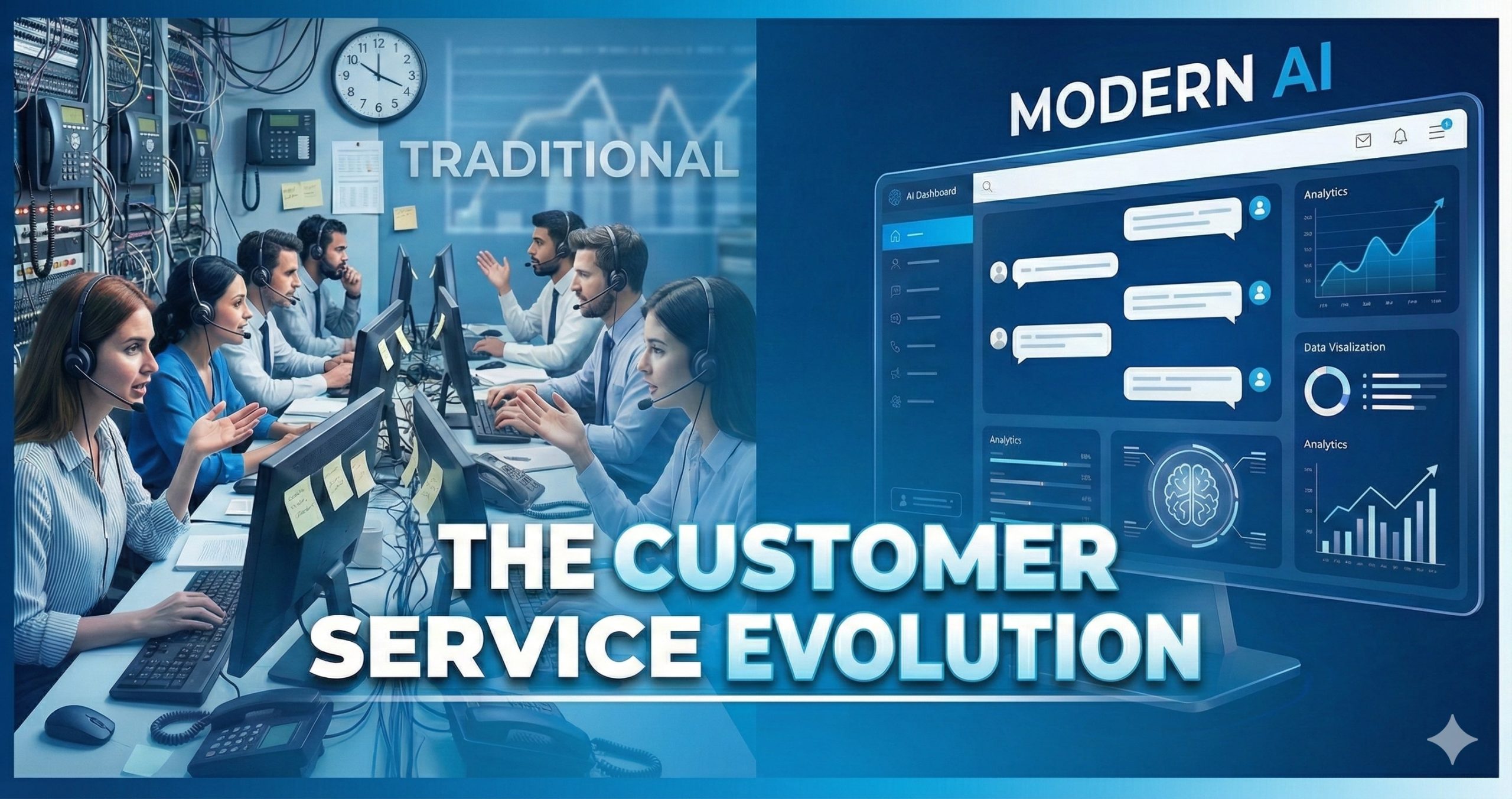

Most companies wait too long to automate their customer service. They endure months or years of inefficiency, mounting costs, and frustrated customers before finally deciding to act.
The result? Lost revenue, burned-out teams, and competitive disadvantage.
Here’s the reality: if you’re experiencing even two of these five signs, you’re already past the point where AI automation would pay for itself within weeks. Let’s explore the clear signals that it’s time to act—and more importantly, how quickly you can actually implement a solution.
Sign #1: Your Support Team is Drowning in Repetitive Queries
🚩 The Red Flags:
You notice that 70-80% of support inquiries are variations of the same questions:
- “Where’s my order?”
- “What are your business hours?”
- “How do I reset my password?”
- “What’s your return policy?”
- “Do you ship to [country]?”
Your talented support agents spend 6-7 hours per day answering these basic questions, leaving minimal time for complex issues that actually require human expertise.
💡 The AI Solution:
Modern conversational AI can handle your top 20-30 most common questions instantly, 24/7, in multiple languages. This isn’t basic chatbot technology—it’s AI that understands context and delivers accurate, helpful responses that customers can’t distinguish from human agents.
The key insight: you’re not replacing humans. You’re freeing them to focus on work that genuinely requires human qualities—empathy, creative problem-solving, relationship building with VIP accounts.
📊 The ROI:
Consider the math: if 10 support agents each spend 6 hours daily on repetitive tasks, that’s 60 agent-hours wasted on questions AI could answer instantly. At an average cost of €40K per agent annually, you’re spending €240K on work that doesn’t require human intelligence.
Companies typically see: 60-70% reduction in routine query volume within the first month, allowing them to either reduce team size or reallocate those resources to high-value activities like proactive customer success.
Sign #2: Slow Response Times Are Costing You Deals
🚩 The Red Flags:
Your average response time is 4-8 hours during business hours, and 24-48 hours on weekends. You’ve noticed:
- Prospects contact you but book with competitors who respond faster
- Your customer satisfaction scores mention “slow response” repeatedly
- Customers message you saying “never mind, I found another solution”
In B2B scenarios especially, being 6 hours slower to respond can mean losing a deal entirely.
💡 The AI Solution:
Instant response, every time. A potential customer asking about product availability at 11 PM gets the same immediate answer as someone asking at 11 AM. No wait times, no “we’ll get back to you,” no lost opportunities.
For complex inquiries requiring human expertise, AI can immediately acknowledge the request, provide preliminary information, and set expectations—then route to the appropriate team member with full context.
📊 The Impact:
Companies implementing conversational AI report:
- Response times dropping from hours to under 30 seconds
- Lead-to-demo conversion rates increasing 30-45%
- Customer satisfaction scores improving 20-30 points
- Win rates improving because they’re first to meaningfully respond
Real example: A mid-market logistics company was losing deals because prospects needed immediate answers about shipping capabilities. After implementing AI, their response time went from 6 hours to 2 minutes—and their win rate increased 35%.
Sign #3: Support Costs Are Scaling Linearly with Growth
🚩 The Red Flags:
Your finance team shows you the numbers:
- Every 100 new customers requires hiring 1-2 new support agents
- Support costs are growing 1:1 with revenue
- You can’t expand to international markets without hiring multilingual staff
- Your support budget is becoming unsustainable
This is the classic scaling trap: growth requires more customers, which requires more support, which eats your margins.
💡 The AI Solution:
AI breaks the linear scaling model. One conversational AI assistant can handle the workload of 8-12 human agents—and it doesn’t matter if it’s handling 100 conversations or 10,000. The cost stays the same.
More importantly, AI handles 100+ languages natively. Want to expand from Italy to France and Spain? No need to hire French and Spanish speakers—your AI already speaks both fluently.
📊 The Economics:
Traditional model:
- 10 support agents × €40K each = €400K annually
- Growth requires proportional hiring
AI-augmented model:
- AI platform: €8K-10K annually
- 2-3 agents for complex issues: €80K-120K annually
- Total: €88K-130K vs €400K
- Savings: €270K-310K annually
Even better: as you grow from 1,000 to 10,000 customers, your AI costs stay essentially flat while your traditional model would require 10x more agents.
Sign #4: You’re Losing Revenue Outside Business Hours
🚩 The Red Flags:
Your analytics show:
- Website traffic peaks at 8-10 PM (after your office closes)
- 40% of visitors land outside business hours
- International customers in different time zones frequently abandon
- Your booking/sales system requires human intervention to complete
You’re essentially closed for business 16 hours per day, even though potential customers are trying to engage with you around the clock.
💡 The AI Solution:
24/7 availability isn’t optional anymore—it’s expected. AI assistants don’t sleep, don’t take weekends off, and don’t need time zones.
Customers can get instant quotes, book appointments, check order status, and complete purchases at 3 AM on Sunday just as easily as 3 PM on Tuesday.
📊 The Revenue Impact:
Companies consistently report that 30-40% of their interactions now happen outside traditional business hours after implementing AI.
Real example: A European events company discovered that 35% of their bookings were now coming from after-hours inquiries—customers who previously would have either forgotten or booked with competitors by the time the office opened. That translated to €150K in additional monthly revenue that was previously invisible.
Sign #5: Multilingual Support Is Out of Reach
🚩 The Red Flags:
You’re losing international opportunities because:
- You can’t afford native speakers for multiple languages
- Google Translate on support tickets looks unprofessional
- International customers frequently abandon after seeing “English only”
- You want to expand to new markets but language barriers block you
Hiring a team of multilingual support agents across European languages alone (IT/EN/FR/ES/DE) could cost €200K+ annually.
💡 The AI Solution:
Modern conversational AI speaks 100+ languages natively—not through clunky translation, but with native-level fluency that understands idioms, context, and cultural nuances.
A customer writing in Italian gets natural Italian responses. Someone switching to Spanish mid-conversation? The AI seamlessly continues in Spanish. It’s not translating word-by-word—it’s genuinely multilingual.
📊 The Market Expansion:
One Italian company’s results:
- Implemented AI with IT/EN/FR/ES support
- Expanded to France and Spain without new hires
- First-year revenue from new markets: €180K
- Cost of multilingual AI: €9K annually
- ROI: 20:1 in year one
How to Actually Implement AI in One Week
Here’s the part most companies get wrong: they think AI implementation takes months of enterprise consulting, complex integrations, and massive IT projects.
Reality: you can go from decision to live deployment in 5-7 days. Here’s how:
Day 1: Discovery & Scoping (2 hours of your time)
- 15-minute assessment call to understand your needs
- Identify your top 20-30 most common support queries
- Determine integration points (CRM, booking system, WhatsApp, etc.)
- Define success metrics
What you need: List of common FAQs, access credentials for systems you want to integrate
Days 2-4: Setup & Configuration (mostly automated)
- AI system configured with your brand voice and knowledge
- Integrations connected (CRM, website chat, WhatsApp, etc.)
- Knowledge base populated with your FAQs and product information
- Initial response templates created
Your involvement: ~2 hours total for review and feedback
Days 5-6: Training & Testing (iterative refinement)
- Test conversations across different scenarios
- Refine responses based on your feedback
- Train on edge cases and complex queries
- Set up escalation rules to human agents when needed
Your involvement: ~3 hours testing and providing feedback
Day 7: Go Live (monitored launch)
- Deploy to live environment
- Monitor initial conversations
- Make real-time adjustments as needed
- Your team focuses on escalated complex cases only
Your involvement: ~1 hour for launch monitoring
Total time investment from your team: ~8 hours over 7 days
That’s it. No six-month enterprise implementations. No massive IT projects. No disruption to operations.
What Happens After Launch?
The first 30 days are about optimization:
- Your AI learns from every conversation
- You refine responses based on customer feedback
- You gradually expand the types of queries AI handles
- Your team focuses increasingly on high-value interactions
Typical timeline:
- Week 1: AI handles 40-50% of queries
- Month 1: AI handles 60-70% of queries
- Month 3: AI handles 70-80% of queries
- Your team: Increasingly focused on complex, high-value customer interactions
The Cost of Waiting
Here’s the uncomfortable truth: every week you wait to implement AI automation, you’re losing:
- Revenue: from after-hours inquiries that never convert
- Efficiency: from agents doing repetitive work instead of high-value activities
- Competitive advantage: as more agile competitors deploy AI first
- Team morale: as your best people burn out on repetitive tasks
If you checked off even 2-3 of the five signs above, the ROI case for AI automation is clear. The typical payback period is 6-10 weeks—meaning by month three, you’re already profitable on the investment.
Ready to Start Your Transformation?
If you’re experiencing two or more of these signs, your business is already past the point where AI automation would pay for itself quickly. The question isn’t whether to implement AI, it’s how soon you can start.
We’d be happy to do a quick 30 minute assessment to explore whether AI makes sense for your specific situation, what implementation would look like, and what ROI you could realistically expect.
- ✓ No credit card required
- ✓ No long-term contracts
- ✓ GDPR compliant - EU data hosting
- ✓ Go live in 3–7 days