
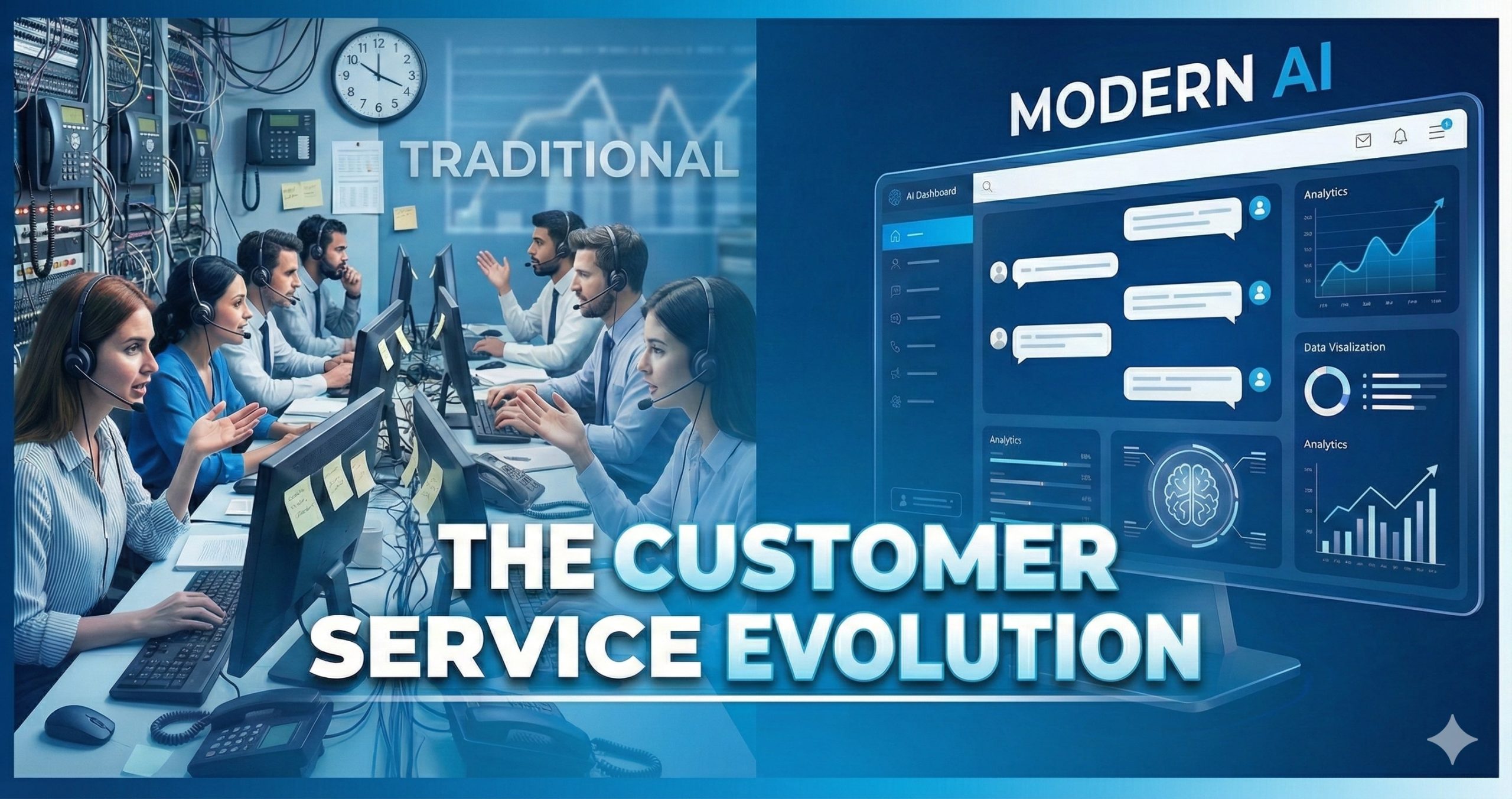
Customer expectations have fundamentally changed. Today’s consumers expect instant responses, 24/7 availability, and personalized service across multiple channels—whether they’re messaging at 2 AM or reaching out via WhatsApp, email, or Instagram.
For mid-market companies—those with 50-500 employees—this creates a particularly challenging situation. You’re caught between two worlds: too large to manage with basic chatbot tools, yet without the enterprise budgets that allow Fortune 500 companies to maintain massive support teams across multiple time zones.
This is where conversational AI is becoming a game-changer. But not the rule-based chatbots of 2018. We’re talking about AI that understands context, learns from interactions, and delivers genuinely helpful responses that customers can’t distinguish from human agents—until they realize they’re getting instant answers at 3 AM on a Sunday.
Let’s explore how this technology is reshaping customer service for mid-market companies, why it matters now, and what it means for your business.
What Exactly is Conversational AI?
Before we dive into the transformation, let’s clarify what we mean by “conversational AI.”
Traditional chatbots follow pre-programmed decision trees. Click Button A, get Response B. They’re rigid, frustrating, and most customers know within three interactions that they’re dealing with a basic bot that can’t truly help them.
Conversational AI is fundamentally different. It uses natural language processing (NLP) and large language models (LLMs) to understand the intent and context behind customer messages. It can:
- Comprehend questions phrased in dozens of different ways
- Remember context from earlier in the conversation
- Handle complex, multi-part queries
- Adapt responses based on customer sentiment
- Learn and improve from every interaction
Think of it as the difference between following a script and having a genuine conversation with someone who understands your needs.
Most importantly, modern conversational AI integrates seamlessly with your existing systems—CRM, inventory management, booking systems, payment processors—turning it into a fully functional member of your team rather than just a FAQ answering machine.
Five Ways Conversational AI is Transforming Customer Service
1. True 24/7 Multilingual Support Without Exponential Hiring Costs
The math of traditional customer service doesn’t scale internationally. Want to serve customers in Italian, English, French, and Spanish? You need native speakers for each language. Want 24/7 coverage? Triple your team size for round-the-clock shifts.
The AI solution: One conversational AI assistant can handle 100+ languages simultaneously, 24 hours a day, 365 days a year. No vacation days, no sick leave, no shift differentials.
For mid-market companies expanding into new European markets, this is transformative. An Italian company can now serve French and Spanish customers with the same quality as their domestic market—without hiring specialized staff for each region.
Real-world impact: Companies report that after implementing AI, 35-40% of their customer interactions now happen outside traditional business hours. That’s revenue and customer satisfaction that was previously impossible to capture without significant cost increases.
2. Response Times Measured in Seconds, Not Hours
Customer expectations for response times have compressed dramatically. Research shows that:
- 46% of customers expect responses within 4 hours
- 12% expect responses within 15 minutes
- For high-value B2B interactions, slower response times directly correlate with lost deals
The reality? Most mid-market support teams average 4-8 hour response times during business hours, and 24-48 hours on weekends.
The AI advantage: Instant responses. Always. A customer asking about product availability at 11 PM gets the same immediate, accurate answer as someone asking at 11 AM.
This isn’t just about customer satisfaction—it’s about conversion rates. When a potential customer is comparing your solution to competitors, the first business to respond meaningfully often wins the deal. Being 6 hours faster to respond can translate directly to revenue.
The numbers: Companies implementing conversational AI report average response times dropping from hours to under 30 seconds, with customer satisfaction scores increasing by 20-30 points.
3. Automatic Lead Qualification That Never Sleeps
Your website gets hundreds or thousands of visitors. Some are ready-to-buy customers. Others are just browsing. Some are tire-kickers. Some are your competitors doing research.
Traditional approaches rely on forms that ask visitors to self-qualify (“What’s your company size? What’s your budget?”)—questions most people skip or lie about.
Conversational AI changes this. By analyzing conversation patterns, sentiment, and specific questions asked, AI can score leads in real-time:
- Questions about pricing and implementation timelines? High intent.
- Asking about enterprise features and integration capabilities? Hot lead.
- Comparing specific features to competitors? Very hot lead—probably evaluating right now.
- Generic questions about “how it works”? Still early stage.
Better yet, the AI can automatically route hot leads to your sales team immediately—even at 2 AM—with a Slack notification and full conversation context. By the time your sales team arrives in the morning, they already know which leads to prioritize.
The impact: Lead-to-demo conversion rates increase by 30-45% because you’re responding instantly and qualifying accurately, without making customers fill out lengthy forms.
4. Seamless CRM Integration That Eliminates Manual Data Entry
Here’s a workflow that many mid-market companies still use:
- Customer sends inquiry via email/chat/form
- Support agent reads inquiry
- Agent manually creates or updates CRM record
- Agent copies relevant details from conversation into CRM notes
- Agent sets follow-up reminder
- Repeat for every interaction
This is time-consuming, error-prone, and means your CRM data is only as good as your team’s data entry discipline.
Modern conversational AI integrates directly with your CRM. Every conversation automatically creates or updates the relevant contact record. Questions asked, products mentioned, objections raised, buying signals shown—all captured in structured data without anyone typing a single note.
The result? Your CRM becomes a genuinely useful source of customer intelligence rather than a database your team reluctantly updates.
Real benefits:
- Sales teams can see complete conversation history before calls
- Marketing can segment based on actual expressed interests and concerns
- Support teams can pick up conversations seamlessly without asking customers to repeat themselves
- Leadership gets accurate data on what customers actually care about
5. Cost Reduction of 60-80% While Improving Service Quality
Let’s talk economics. A customer service agent costs approximately €35,000-50,000 annually in Europe when you factor in salary, benefits, training, and overhead. For a team of 10 agents, that’s €350,000-500,000 per year.
Now consider that research consistently shows 60-80% of customer service inquiries are repetitive and routine:
- “Where’s my order?”
- “What are your business hours?”
- “How do I reset my password?”
- “What’s your return policy?”
- “Do you ship to [country]?”
These questions don’t require human intelligence or empathy—they require fast, accurate information delivery. Yet they consume the majority of your team’s time, leaving them stressed and unable to focus on complex issues that truly benefit from human expertise.
The AI transformation: Conversational AI handles the routine 70-80%, allowing you to reduce your team size or (better yet) reallocate those team members to high-value activities: complex problem-solving, proactive customer success outreach, and relationship building with VIP accounts.
The math: A mid-market company with 10 support agents can often reduce to 2-3 agents plus AI, maintaining or improving service quality while cutting costs by €250,000-350,000 annually.
But here’s the key insight: this isn’t about replacing humans. It’s about freeing humans to do the work that actually requires human qualities—empathy, creativity, complex reasoning, relationship building.
Real-World Impact: What Companies Are Experiencing
While we can’t share specific client names without permission, the patterns are remarkably consistent across industries:
A European logistics company was drowning in tracking inquiries—thousands per day during peak seasons. After implementing conversational AI, they went from 18 support staff to 4, while simultaneously improving customer satisfaction scores because customers now get instant tracking updates via WhatsApp rather than waiting hours for email responses.
A luxury fashion brand needed to maintain their premium brand experience while scaling. Their AI assistant handles initial inquiries in multiple languages at any hour, escalating only when customers need styling advice or have complex issues. Response times dropped from 24-48 hours to under 5 minutes, and their small support team now focuses exclusively on VIP customer relationships.
An events and hospitality company saw 40% of their bookings starting to come from after-hours inquiries. Before AI, these leads would wait until morning—by which time, many had already booked competitors. Now they capture those bookings immediately, adding roughly 35% to their revenue without increasing staff.
The common thread? These aren’t companies replacing human service with robots. They’re companies augmenting human capabilities with AI, focusing human talent where it matters most.
How to Get Started: Practical Steps
If you’re considering conversational AI for your customer service, here’s a practical roadmap:
Step 1: Audit Your Current Support Volume
Spend a week analyzing your incoming support requests:
- What percentage are truly routine and repetitive?
- What are the top 20-30 questions you receive?
- When do inquiries come in (are you missing after-hours opportunities)?
- Which languages do your customers speak?
Typically, companies discover that 70-80% of their volume consists of roughly 30 distinct question types. That’s your AI opportunity.
Step 2: Calculate Your Current Costs
What are you actually spending on customer support today?
- Staff salaries and benefits
- Tools and software
- Training and onboarding
- Opportunity cost of slow response times (lost deals)
Be honest about the full cost, including management time.
Step 3: Define Success Metrics
What would success look like for your company?
- Reduced response times?
- Lower support costs?
- Higher customer satisfaction scores?
- Ability to serve international markets?
- More time for proactive customer success work?
Step 4: Start Small, Scale Fast
You don’t need to automate everything on day one. Most successful implementations follow a pattern:
Week 1: Deploy AI for your top 10-15 most common questions Week 2-4: Monitor, refine, expand to top 30 questions
Month 2-3: Add integrations (CRM, booking systems, etc.) Month 3-6: Expand to new channels and languages as needed
The key is choosing an implementation partner who can get you live quickly—days or weeks, not months. Long enterprise implementations often fail because requirements change, stakeholders lose interest, and you’re solving last quarter’s problems instead of today’s.
The Bottom Line
Conversational AI isn’t future technology—it’s here now, and mid-market companies are using it to compete effectively against both smaller competitors (who can’t afford the technology) and larger ones (who move too slowly to implement it effectively).
The transformation isn’t about replacing human customer service. It’s about augmenting your team’s capabilities, allowing them to focus on work that genuinely requires human empathy, creativity, and problem-solving while AI handles the routine, repetitive, and time-sensitive inquiries that consume most of their day.
For mid-market companies specifically, this represents a rare opportunity to gain an advantage: you’re large enough to benefit from the cost savings and efficiency gains, but small enough to implement quickly and adapt rapidly.
The companies that will win in 2025 and beyond aren’t necessarily those with the biggest support teams—they’re the ones who smartly blend AI capabilities with human expertise, delivering better service at lower costs while freeing their talented people to do more meaningful work.
The question isn’t whether to adopt conversational AI. The question is: how soon can you start?
Ready to Transform Your Customer Service?
Book a 30 minute demo and see your AI assistant in action. Implementation starts in 48 hours.
- ✓ No credit card required
- ✓ No long-term contracts
- ✓ GDPR compliant - EU data hosting
- ✓ Go live in 3–7 days